Less Is More: Why the Smartest Solo Artists Are Cutting Their Setlists in Half
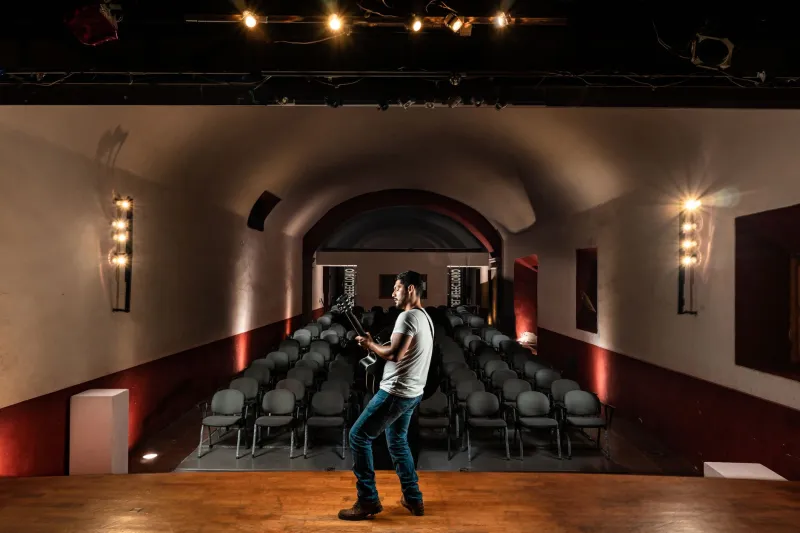
There's a quiet revolution happening on small stages across the country, and it doesn't involve flashier lights or bigger speakers. It involves doing less.
More and more solo artists are walking out with shorter setlists — sometimes dramatically shorter — and walking off with something far more valuable: rooms full of people who feel genuinely seen. Not entertained. Not impressed. Seen. And in the solo artist game, that's the whole ballgame.
The More-Is-More Trap
For a long time, the unspoken rule of live performance was pretty simple: give people as much as possible. Pack the setlist. Fill every minute. Make sure nobody feels like they didn't get their money's worth. It's the buffet logic of live music, and honestly? It makes sense on paper.
But here's the thing about buffets — you rarely remember what you ate.
Asha Colman, an indie folk singer based out of Nashville who's been playing the circuit for about six years, learned this the hard way. "I used to do 18, 20 songs a night," she says. "I thought I was giving people everything. But when I'd talk to fans afterward, they'd be like, 'Oh yeah, that one song was amazing' — and they meant the one I almost cut because I thought it was too slow."
What Colman noticed was that the songs people remembered weren't the ones she played most. They were the ones she talked about. The ones with a story attached. The ones where she paused, took a breath, and let the room catch up with her.
So she cut her setlist down to 10 songs. Then 9. She started treating each track like it had to earn its spot — not just musically, but emotionally.
"My merch sales went up. My email signups went up. People started staying after the show longer," she says. "Nothing changed except I stopped trying to do so much."
What the Psychology Actually Says
This isn't just anecdotal. There's real behavioral science behind why focused experiences land harder than exhaustive ones.
Psychologists have long studied what's called the "peak-end rule" — the idea that people judge an experience based on how they felt at its most intense moment and at the very end, not based on the average of the whole thing. A two-hour show with one transcendent moment and a flat ending will be remembered worse than a 45-minute set that builds to something unforgettable and closes on a gut punch.
For solo artists especially, this is huge. You don't have a band to fill sonic space. You don't have pyrotechnics to paper over the quiet moments. It's just you and the room, and every minute of that setlist is a negotiation between what you want to play and what the audience can actually absorb.
When you cram in too many songs, you're essentially asking your audience to sprint a marathon. They'll keep up for a while, then gradually check out — not because they don't like you, but because the human brain can only hold so much emotional information before it starts filing things under "background noise."
The Space Between Songs Is Where the Magic Lives
Ask any solo artist who's figured this out and they'll tell you the same thing: the between-song moments matter just as much as the songs themselves.
Marco Reyes, a singer-songwriter out of Austin who plays a mix of originals and stripped-down covers, made a deliberate shift about two years ago. He started treating the transitions in his set like part of the performance — not dead air to fill nervously, but intentional breathing room.
"I started telling the real story behind a song before I played it. Not the polished version I'd say at a bigger venue, but the actual story," he explains. "Like, 'I wrote this at 2 a.m. in a parking lot because I didn't want to go back inside and have the conversation I knew I needed to have.' People lose it for that stuff."
Reyes dropped from 16 songs per set to around 11, but stretched his performance time by about 15 minutes by leaning into those moments. Fan engagement on his socials spiked after shows. People were quoting his stories back to him in comments, not just his lyrics.
"It stopped feeling like a concert and started feeling like a conversation," he says. "And a conversation is something people actually remember."
Curating With Intention, Not Obligation
So how do you actually build one of these tighter, more intentional setlists? The artists who've cracked this tend to follow a few loose principles.
Lead with something that drops people in fast. You've got maybe 90 seconds before the audience decides whether they're with you or just waiting to see. Your opener doesn't have to be your biggest song — it just has to feel like a door opening, not a door slamming.
Treat your set like a short story, not a catalog. There should be an arc. A build. A place where things get quiet and uncomfortable in the best way. A moment where you let the room breathe. And an ending that feels earned, not just final.
Cut the songs you're playing out of habit. If you've been playing a song for three years and you're not excited about it anymore, the audience can feel that. Every track on a short setlist has to carry its own weight, or it drags everything else down.
Don't be afraid of the quiet. Solo performance lives in vulnerability. A pause that feels too long to you probably feels just right to the person in the third row who needed a second to process what you just played.
The Counterintuitive Truth About Value
Here's the thing that trips a lot of independent artists up: they confuse quantity with value. They think a longer show means the audience got more. But value in a live music context isn't measured in minutes — it's measured in moments.
One moment where someone in the crowd tears up because a lyric hit exactly right is worth more than 45 minutes of technically solid performance that never quite landed. And the cruel irony is that chasing quantity often kills your shot at those moments, because you never slow down long enough to let them happen.
Solo artists have a unique advantage here. No band to coordinate with. No label breathing down your neck about set length. No one telling you the show has to be 90 minutes because that's what they booked. It's just you, a room, and the freedom to make choices that actually serve the music.
That freedom is the whole point of going independent. Might as well use it.
One Voice, Used Wisely
At SoloSong, we talk a lot about the power of a single voice to tell infinite stories. But here's the flip side of that: a single voice also has to make choices about which stories to tell, and when, and how much space to give each one.
The artists who are figuring this out aren't playing fewer songs because they're lazy or underprepared. They're playing fewer songs because they understand that attention is a gift, and you don't waste gifts.
So next time you're building a setlist, maybe ask yourself: not "how many songs can I fit?" but "which songs actually need to be here?"
The answer might surprise you. And so might the response from the room.