Just You and a Room Full of Strangers: The Strange Magic of Performing Alone
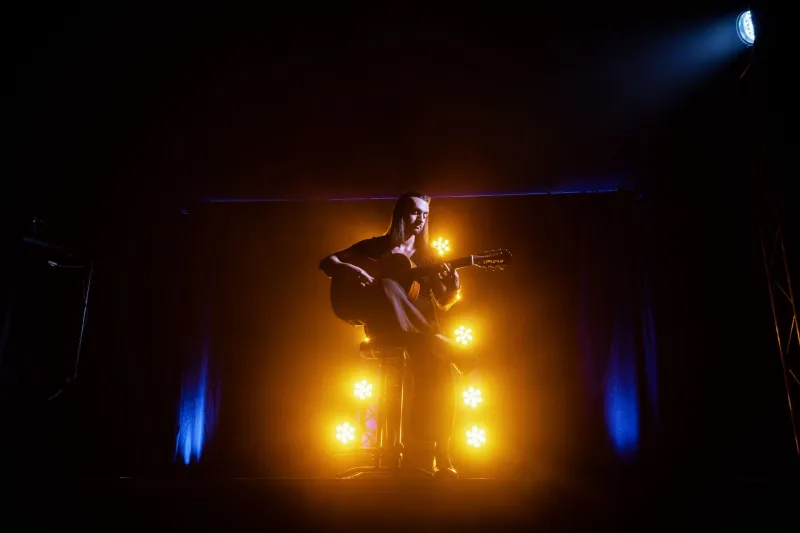
Picture this: a single spotlight, a guitar, maybe a loop pedal humming quietly in the corner. No drummer counting in the beat. No bassist holding down the low end. No bandmate to glance at when you forget a lyric. It's just you, your instrument, and two hundred people who came out on a Wednesday night to watch you be completely, uncomfortably human.
For a lot of people, that sounds terrifying. For solo artists, it often ends up being the most alive they've ever felt.
This is the paradox that keeps coming up when you talk to independent musicians about their live show experiences — the idea that stripping everything away, removing every layer of sonic and social armor, somehow creates more connection, not less. It's the kind of thing that doesn't make sense on paper until you've either performed it or sat in the audience for it.
The Intimacy That Bands Can't Buy
There's a reason why unplugged sets and acoustic showcases have never really gone out of style. From the early folk revival coffeehouses of Greenwich Village to the MTV Unplugged era to today's living room concert streams on Instagram Live, audiences have always gravitated toward the stripped-back moment. And it's not just nostalgia.
When there's no band filling space, every pause matters. Every breath is audible. Every slightly cracked note is right there in the open. And weirdly — that vulnerability is magnetic.
Singer-songwriter Maya Telles, who performs regularly across small venues in the Pacific Northwest, describes it this way: "When I'm up there alone, I can't hide behind anything. The audience knows it, and I know it. But that shared understanding — that we're all just here together in this kind of naked moment — that's when people actually lean in."
She's onto something that psychologists who study performance have talked about for years. Vulnerability, when it's authentic, triggers empathy. Audiences aren't just watching; they're feeling with the performer. And when there's a full band on stage, the dynamic subtly shifts — the audience becomes observers of a group. When it's one person, the dynamic becomes something closer to a conversation.
The Loneliness Myth
Ask most solo artists about the loneliness of performing without a band and you'll get a complicated answer. Yes, the green room is quieter. Yes, load-in is a solo sport. Yes, there's no one to grab a post-show beer with who went through the exact same set you just did.
But the stage itself? That's a different story.
Jordan Reyes, an indie folk artist based out of Austin who's been touring solo for the better part of five years, puts it plainly: "I've played with bands before. Big ones. And I always felt kind of... separated from the crowd. Like we were presenting something at them. When I started doing solo shows, I realized the audience becomes part of the performance in a way they never were before. They fill the silence. They're almost like bandmates."
That idea — the audience as an invisible collaborator — comes up again and again in conversations with solo performers. Without the buffer of other musicians, the energy exchange between artist and crowd becomes more direct, more immediate. A solo performer reads the room differently. They can slow down a song mid-set because they felt the energy shift. They can stop and tell a story between verses without worrying about throwing off a bandmate's timing. The whole show becomes fluid, responsive, alive in a way that a tightly rehearsed group performance sometimes can't be.
When the Silence Hits Different
There's also something to be said about what happens in the quiet moments — the spaces between the notes that solo artists learn to use like instruments themselves.
In a band setting, silence is usually something to be filled, managed, avoided. In a solo performance, silence can be the most powerful beat in the room. Artists who've mastered the solo format often talk about learning to sit in those moments, to let the audience feel the weight of a lyric before moving on.
Natalie Shores, a classically trained vocalist who transitioned to performing her original material solo across small theaters in the Midwest, describes one particular show in Columbus, Ohio, as a turning point: "I was performing a song about my mom, and I just — I stopped. I couldn't finish the line. And instead of it being this awful, embarrassing moment, the whole room just... held it with me. Someone in the third row was crying. I could hear it. That would never have happened the same way with a full band behind me. The silence had nowhere to go except into the audience."
That story captures something essential about the solo performance experience. The absence of a band doesn't create emptiness — it creates space. And space, in a live performance context, is where human connection lives.
Isolation as a Superpower
It might sound like a stretch to call the grueling, often lonely work of being a solo artist a superpower — but hear it out. The same isolation that makes the business side of independence hard is exactly what trains solo performers to be extraordinarily attuned to their own emotional landscape. And that attunement is what audiences feel when they watch someone perform alone.
Because here's the thing: you can't fake a solo performance the way you can sometimes get by in a band. There's no energy to borrow from a bassist who's having a great night. There's no drummer keeping the momentum going while you gather yourself. It's all you, all the time. And that pressure — that beautiful, awful pressure — tends to produce performers who are deeply present, deeply honest, and deeply in tune with the people watching them.
For independent musicians who've chosen the solo path, this is often the thing they'd never trade. Not the streaming numbers, not the creative control, not the freedom to set their own touring schedule. It's the shows. The rooms. The strange, electric feeling of standing alone in front of a crowd and somehow feeling like you've never been less alone in your life.
The Takeaway
The paradox of solo performance isn't really a paradox at all once you've lived it. Performing alone doesn't mean performing in isolation — it means removing every barrier between the artist and the audience until what's left is just two parties in a room, being honest with each other.
For solo artists, that's not a limitation. That's the whole point.
And for the audiences lucky enough to be in those rooms? It's the kind of show you don't forget — the kind where you walked in as a stranger and walked out feeling like you'd heard something meant specifically for you.