The Art of Saying Nothing: How the Smartest Solo Artists Are Weaponizing Silence
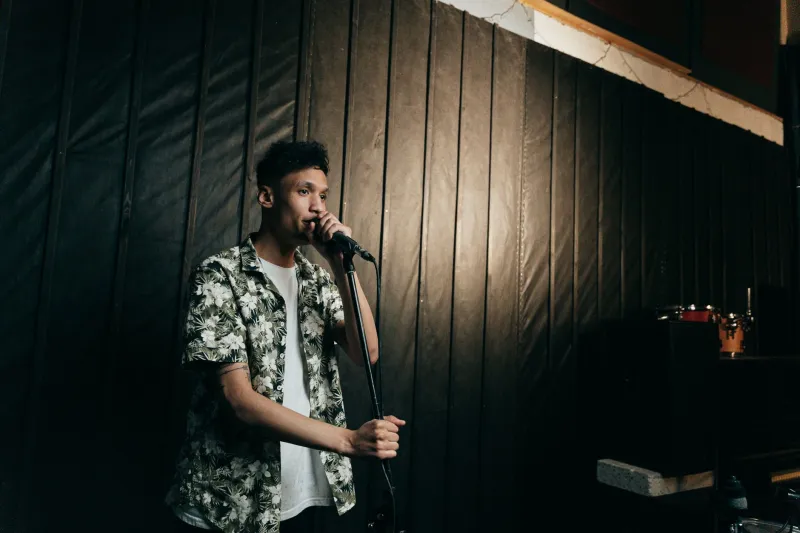
There's a moment in a great live performance that doesn't get talked about enough. It's not the climactic note, the crowd singalong, or the perfectly timed key change. It's the second just before all of that — when the artist pulls back, lets the room breathe, and does absolutely nothing.
And somehow, that nothing hits harder than everything.
For a generation of solo musicians raised on the idea that more is more — more layers, more production, more content, more output — the growing embrace of restraint feels almost rebellious. But across basement venues in Nashville, coffee shop stages in Portland, and bedroom recording setups in Brooklyn, independent artists are quietly (pun intended) figuring out something that the most decorated composers in history already knew: silence isn't the absence of music. It's part of the music.
The Psychology Behind the Pause
Human brains are wired to assign meaning to gaps. When sound suddenly stops, our nervous systems don't relax — they lean in. Psychologists call this the "orienting response," and it's the same mechanism that makes you look up when someone stops talking mid-sentence. In a musical context, that reflex becomes an emotional tool.
Solo artists, arguably more than anyone else in the performance world, have direct access to this lever. Without a full band to fill the space, a single performer can create silence that feels intentional rather than accidental. The audience doesn't wonder if someone missed a cue. They wonder what comes next.
That anticipation? That's the instrument.
Jordan Faye, an independent singer-songwriter based out of Asheville, North Carolina, started experimenting with extended pauses after noticing something unexpected at her shows. "I'd forget a lyric and freeze for a second, and the room would just go completely still," she says. "Not awkward still — like, held still. And I thought, what if I did that on purpose?"
She started building deliberate five-to-eight second silences into her set, particularly after emotionally heavy verses. The result, she says, was that audiences started crying at moments they hadn't cried at before. "The silence gave them permission to feel it. When I kept playing, I was kind of rushing them through."
Space as Arrangement
In recording, the same principle applies — and it's changing the way independent artists think about production.
For decades, the instinct in bedroom production has been to layer. Add a pad here, a counter-melody there, fill the low end, fill the high end, make it feel full. Streaming platforms and the loudness wars of the 2000s only reinforced that instinct. But a new wave of solo producers is pushing back.
Marco Ellis, who records under the name Sundial Static and self-releases everything through Bandcamp and DistroKid, describes his production philosophy as "subtractive storytelling." He starts every track with more than he needs, then removes until something feels true.
"I'll have a full arrangement — drums, synths, bass, the whole thing — and then I'll mute everything except the vocal and one guitar for sixteen bars," he explains. "And usually that stripped section ends up being the part people screenshot and post. The part they DM me about. The quiet part."
He's noticed that streaming listeners, conditioned to skip after a few seconds, actually pause when the production drops out. "It's counterintuitive, but emptiness stops the scroll."
The Invisible Setlist
There's a concept floating around in independent music circles that some artists are calling the "invisible setlist" — the unspoken architecture of a performance built not just from songs, but from the spaces between them. The tuning break that doubles as a breather. The unaccompanied vocal line that strips away every layer of safety. The held chord that rings out while the performer just... stands there.
These moments don't appear on any set list. They're not rehearsed in the traditional sense. But the artists who use them intentionally say they've become some of the most talked-about parts of their shows.
Clara Mims, who plays acoustic folk around the Texas circuit and has built a following largely through her live reputation, describes her use of silence as "emotional punctuation." She'll finish a verse about grief or longing and simply wait — hands off the strings, eyes up — before moving to the chorus.
"I used to feel like I had to keep going, like stopping meant I was failing," she admits. "Now I think of it as giving the lyric somewhere to land. If I rush into the next chord, I'm basically telling the audience not to feel anything yet."
Her audiences have noticed. She regularly gets comments along the lines of I don't know what you did in that moment, but I lost it. She knows exactly what she did. She did nothing.
Learning to Trust the Room
For a lot of solo artists, the hardest part of embracing silence is the vulnerability of it. When you're one person on a stage with no band behind you, silence can feel like exposure. There's no drummer to fill the gap, no bassist to cover while you collect yourself. It's just you and a room full of people waiting.
But that exposure, several artists argue, is exactly the point.
"The audience can feel when you trust them," says Jordan Faye. "When you stop playing and just let the room hold it, you're saying, 'I believe you can handle this.' And people respond to being trusted."
It's a fundamentally different relationship than the one created by constant sound. Filling every moment keeps the audience at a comfortable distance. Silence invites them in.
What You Don't Play
Miles Davis famously said it's the notes you don't play that matter. It's the kind of quote that gets slapped on inspirational posters and promptly ignored in practice. But the solo artists leaning into restraint are living proof that the idea still holds.
In a content landscape that rewards volume — more posts, more releases, more everything — choosing to leave space is almost a countercultural act. It requires trusting that less will do more. That a breath can hit harder than a riff. That a room held in silence for five seconds can feel more alive than one filled with sound.
For independent musicians trying to carve out something real in a noisy world, that might just be the most powerful tool in the whole set.
The song you don't finish. The note you don't resolve. The moment you just stop and let it breathe.
Sometimes that's the whole performance.